Made to measure shower screens, and how to spot the ones that are not
The phrase covers everything from a catalogue panel in an adjustable channel to glass templated to a leaning wall. The difference matters, because only one of them will fit a room where nothing is square.
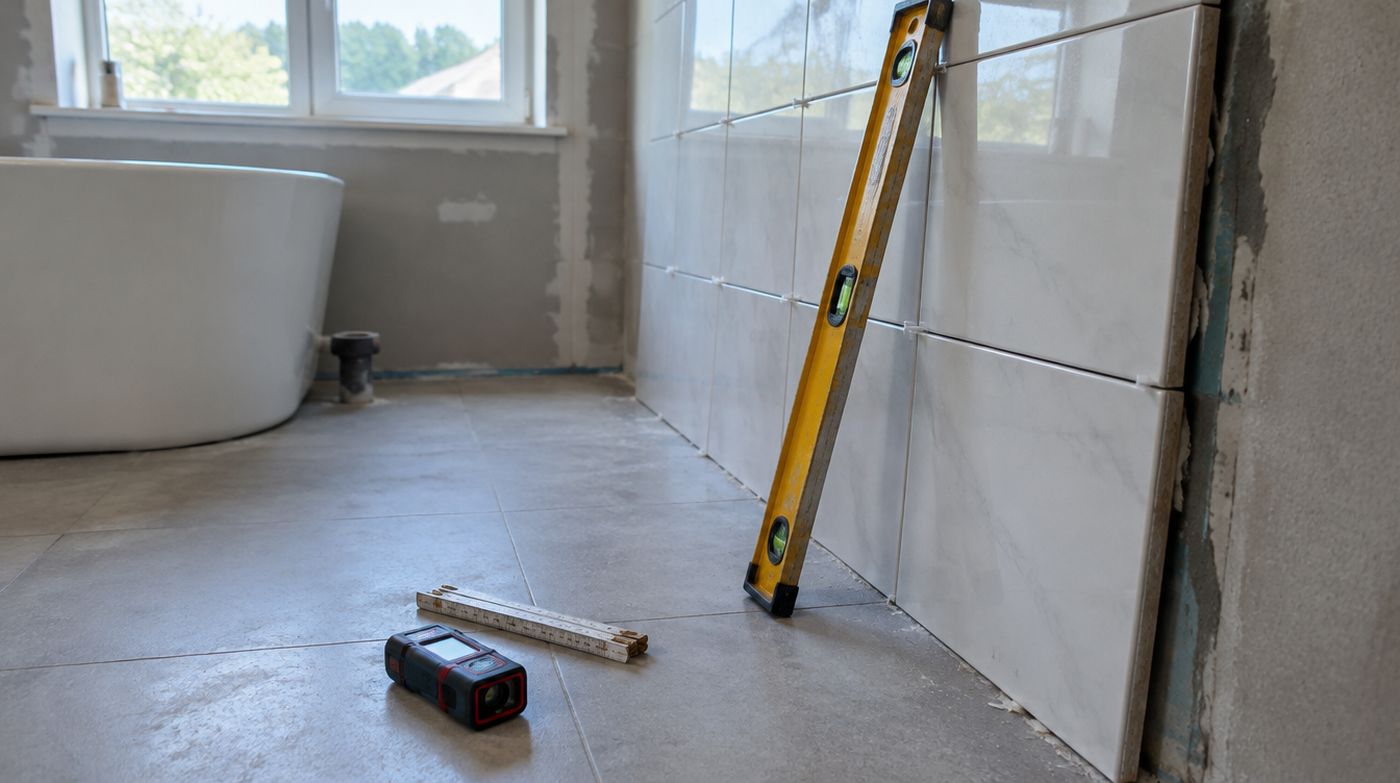
Made to measure, cut to size and adjustable are three different products
Three things get sold as made to measure shower screens, and only one of them is actually made to your room. The first is a stock panel in an adjustable wall channel: the glass is a catalogue size, and a profile with fifteen to twenty five millimetres of movement in it swallows whatever your wall is doing. The second is cut to size, where a standard profile system takes glass ordered to a width and height off a chart. The panel is still rectangular and still assumes your corners are right angles. The third is the real thing, where the glass is cut, notched, raked and scribed to a template taken in the room, and nothing about the panel is rectangular unless the room is.
All three are honest products. They are not interchangeable, and they do not cost remotely the same. The trouble starts when the second one is priced like the third.
So here is the first thing worth saying plainly. If your bathroom is a square box with plumb, flat, newly tiled walls, you do not need any of this. Buy a good stock enclosure from a merchant, pay a competent fitter to install it properly on a level tray, and put the money you saved into the tiling or a better thermostatic valve. This workshop is set up for lofts with the ceiling coming down over the shower, period rooms where no two walls agree, and walk-ins wider than anything in a catalogue. A square 900 by 900 corner is not that job.
How do you tell from a written quote which one you are getting?
Quotes for made to measure shower screens rarely volunteer which of the three products they are, so read the quote for what is missing rather than what it promises. A panel described as 900 x 1950 is a catalogue size. A panel described as 884 x 1973 has come from a measurement. If the glass dimensions are given in round hundreds, the room has not decided them.
Look for a survey or template date in the document. A genuine made to measure order has a point in it where somebody stood in the bathroom with a level, a long straight edge and a laser, and that visit has to happen before the glass is cut. If the paperwork goes straight from deposit to fitting date with nothing in between, the sizes were chosen at the point of order.
Look for the word adjustment, or for a wall channel listed as a component. Neither is a problem in itself. A slim adjustable profile is a sensible, cheap way to deal with a wall that leans a few millimetres. But a quote that relies on the channel to cope with your wall is selling you a stock panel, and should be priced as one.
Then ask one question in writing: what are the finished glass dimensions, and at what point in the process are they fixed? The answer tells you everything. Decided now, from the sizes you gave over the phone, means cut to size. Decided after a template, from the maker’s own measurements, means made to measure. Companies get uncomfortable with that question when the answer is the first one and the price is the second one.
Who carries the tolerance when the glass is wrong?
This is the real difference between the products, and almost nobody explains it. An adjustable profile exists to absorb error. It gives the fitter somewhere to hide a wall that is out by fifteen millimetres, and it means the glass does not have to be accurate because the channel is. Hand the same error to a made to measure panel and there is nowhere for it to go. A scribed edge has to land within a millimetre or two of the wall it was cut to follow, because the silicone line is the only thing covering the difference and a 6mm silicone line looks like what it is.
That shifts the risk onto whoever took the measurements. If we template a raked panel for a loft in Crouch End and get the angle wrong by half a degree, the panel is scrap and that is our problem, not yours. Ask any company quoting bespoke work the same thing: if the glass does not fit, who pays for the second one? A maker with its own cutting and toughening facility can answer that straight away, because a re-make costs it materials and a week. A reseller ordering from a trade supplier is answering for somebody else, which is why the answer gets vague.
Get it in writing. One line saying the glass is supplied to the maker’s own survey dimensions and any re-make arising from those dimensions is at the maker’s cost is worth more than any guarantee certificate.
What a survey on an out of square room has to produce
Measuring an awkward bathroom is not a tape measure job. On a room where the walls lean, the survey has to record the plumb deviation at the head and the foot of every wall the glass touches, the bow across the run, and the floor level across the full width of the opening. A wall that is 12mm out at the top and a floor that drops 6mm across the door are two separate problems and they do not cancel out.
It also has to record what is behind the tile. A made to measure panel is only as good as its fixings, and the difference between 100mm of brick, a timber stud at 400mm centres and 50mm of dot and dab plasterboard over blockwork changes the hardware specification before the glass is cut. Where ceilings rake across the screen line there is a separate set of measurements again, and we cover that properly on the sloping ceiling page rather than repeating it here.
One more thing from the survey that people underestimate: the state of the room on the day. Measuring off bare plaster and allowing a nominal 12mm for tile and adhesive is how panels end up eight millimetres short, because large format porcelain on a notched trowel is not 12mm and nobody tells the glass maker. If the tiles are not on, the sizes carry an assumption, and you should be told what that assumption is in millimetres.
Three jobs where cut to size beats made to measure shower screens
A wall that leans two or three millimetres over two metres does not need scribed glass. It needs a cut to size panel in a slim matching profile, which costs a fraction of the bespoke price and will look clean for years. Honest tolerance assessment is part of a survey, and if we measure your room and it is nearly square, we will tell you so.
A rental property or a flat you intend to sell inside a couple of years is not where bespoke glass earns its money either. A tenant will not notice the difference between scribed glass and a silicone joint, and no buyer has ever paid more for a shower screen. Spend the budget on the things a survey or a viewing picks up.
The third case is the one people get wrong most often. If the wall is so bad that the glass would have to follow a bow of twenty or thirty millimetres, the right answer is often to have the plasterer float that one wall flat first and then fit a standard panel to it. Two bags of bonding and half a day of labour is cheaper than curved scribing, and the finished bathroom is better. We would rather tell you that at survey than take the order.
The point where a made to measure order freezes
Every hole, notch, radius and rake has to be in the glass before it goes through the toughening furnace. Toughened glass made to BS EN 12150 cannot be cut, drilled or ground afterwards. Try it and the panel does not chip, it dices into a pile of fragments. That single fact drives the whole sequence of a bespoke order and explains why the process looks slower than buying off a shelf.
The order runs survey and template, then a dimensioned drawing for you to sign, then cutting, edge polishing and notching in the Wembley workshop, then toughening, then fitting. The drawing is your last chance to move a hinge, change a notch or raise a panel height. After that the sizes are in the glass. If a company will not show you a dimensioned drawing before cutting, you are approving nothing and you will find out whether it is right on fitting day.
It also means a change of mind about hardware position is a new panel, not an adjustment. Made to measure shower screens get made once. Decide where the handle, the hinges and the bracing go while it is still a drawing.
What to put in writing before you pay a deposit
- Finished glass sizes in millimetres, stated as survey dimensions rather than nominal sizes.
- Glass thickness, toughening standard and the position of the kitemark or stamp on the panel.
- Edgework: polished, ground or bevelled, and on which edges.
- Every notch, rake and cut-out shown on a drawing with dimensions.
- Hardware schedule by item, with the fixing substrate named for each one.
- The date of the survey, and confirmation that the glass is cut to that survey.
- Who pays for a re-make if the panel does not fit.
- Who makes good the tiling if a fixing position has to move on site.
None of that is unreasonable to ask for and all of it should already exist in a properly run order. We work from our own survey, cut and process the glass in our own workshop at 6 Atlas Road in Wembley, and fit with our own installers rather than subcontractors, which is why we can carry those commitments. If you want the room looked at before you commit to anything, the survey is free and the quotation is a fixed written price. Call 020 4634 6045, Monday to Friday, 8am to 5pm.
FAQ
Questions about made to measure shower screens
What does made to measure actually mean on a shower screen?
It should mean the glass is cut to dimensions taken from your room, after a survey, with any notches and angles cut before the panel is toughened. In practice the phrase is also used for cut to size glass ordered off a size chart, and for stock panels fitted in an adjustable wall channel. The test is when the finished glass dimensions are decided. If they were chosen at the point of order, from sizes you supplied, the panel is cut to size. If they come from the maker’s own template, it is made to measure.
Can you make a shower screen to fit an existing shower tray?
Usually yes, and it is a common request when a tray is tiled in and nobody wants to disturb it. The survey needs the tray’s actual upstand height, its level across both axes and the exact position of the raised lip, because older trays are rarely flat and a panel sitting on a tray that falls 5mm to one end will show a tapering silicone line. If the tray is cracked, moves underfoot or has no fall to the waste, replacing it first is the better spend. Fitting new glass to a failing tray is money on top of a problem.
Do I need to be tiled before you can template a made to measure screen?
It is better if you are. Templating finished tiled surfaces removes the biggest assumption in the whole job, because the glass is then cut to the surface it will actually seal against. If the tiling is not done, we can survey off the substrate and allow a stated thickness for tile and adhesive, but that allowance has to be agreed in millimetres and the tiler has to stick to it. Large format porcelain on a notched bed is often nearer 20mm than the 12mm people assume, and that error is enough to spoil a scribed edge.
Send us a photo of the awkward bit
A picture of the slope, the beam or the wall that is causing the problem tells us more than a set of measurements. We template across London.